green hair

A few months back now, I had a little hair dilemma.

My head had decided it would no longer tolerate the stuff I was trying to wash my hair with. No. Instead my head decided to cover itself with painful red lumps that would only go away if I switched shampoos. Ok, so I had developed an odd little/big reaction to my normal shampoo that I had  been using for quite some time.  So I switched…and I switched….and then I switched some more. Nothing was quite right. All the ‘greener’ options either made my hair look the end of a fox’s tail (which is fine if that’s the look you are going for…but I wasn’t.) Or didn’t quite clean as I had hoped for, leaving hair greasy after consecutive washes.

What to do? What to do?

Then two lovely bloggers that I follow, (Multiple Mum and Bruise Mouse ) posted in the same week of using bicarbonate soda and apple cider vinegar for hair washing. It was a sign. I had nothing to lose but some greasy locks and a few painful lumps or two right?

I had read about this method a long time ago but hadn’t taken the plunge yet. I had also read that it might take a few days/weeks to adjust to the new method, but from my experience it was fine from the beginning. Actually it was more than fine. It was great! Clean hair, no residual smell, hair is soft, and has more oomph than it’s had in a long time. Swish, swish, swish…

The method I’ve been using is-

1 teaspoon of bicarbonate soda mixed with about 80mls of water to make a runny solution. I work that in to the roots and scalp then rinse out with water. I do it on dry hair initially as the bicarb doesn’t lather up at all and if it’s done on dry I can tell where I have ‘shampooed’.

2 tablespoons apple cider vinegar mixed with about 700mls water poured over ends. Leave for a few minutes and then rinse out with water.

* Since starting this I have found these two combinations can be a little drying to my hair, so have worked out the best solution for me at the moment is to use regular conditioner alternately with the apple cider vinegar. 

A few weeks in after switching and the lovely Christine also posted on her method for conditioning using rosemary and apple cider vinegar here.

Three months later, and I couldn’t be happier. It is kind of funny that I use the same product for washing my hair, cleaning my bathroom and making my Anzac Biscuits, but hey…it works, and it works really well.

**********

Now while I’m talking of green hair, let’s have a little peek at green hair removal, now I’m not talking of hair on the top of your head…

Hair. Some people love it. Some people hate it. Some people have it. Some people don’t.

Hair options are many.

Shaving, waxing, laser, threading, sugaring, epilation, depilation are some of the methods to take it all off.

Or you can simply grow it.

Hair removal options

Shaving– reusable razors with disposable heads or disposable plastic razors. The disposables make up a huge amount of plastic landfill each year. Hair starts growing immediately.

Waxing– Lots of different brands out there. Some plant based and some petroleum-based. Hair gets sparser as waxing continues. Cotton strips, plastic strips, wooden strips can all be used for slapping the wax on.

Laser– long term hair loss results. Lots of equipment used.

Depilation– creams that dissolve the hair with a whole lot of stinky chemicals at skin level.

Epilation– hair taken from just below the skin’s surface. Electronic or battery operated machines usually used.

So what are the ‘greenest’ hair removal options?

Sugaring-sugar waxing”, hair taken from the root using sugar, water and lemon juice or vinegar.

Threading– a piece of cotton used, takes the hair from the root level. (I love this one. Small thread of cotton a few twists and whoosh!)


Or simply…

Grow it– grow it and be proud.


the weight of the steak


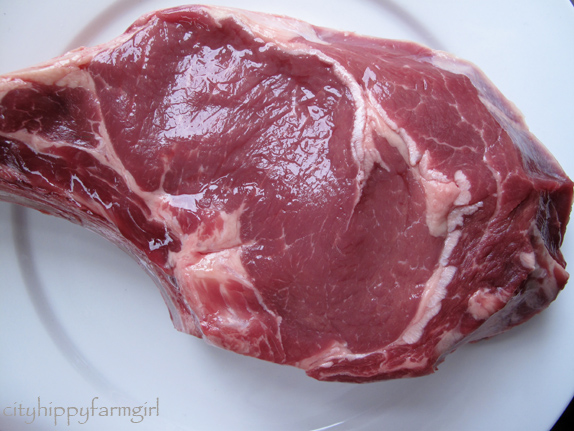
When I was researching what piggy options a city girl had, I discovered Feather and Bone, in Rozelle. A supplier of sustainably raised meat. I started getting their weekly emails filled with interesting meaty information and what’s on offer at the moment. From there, I went to one of their open days and got to see for myself at how it was all done, coming home with a weighty little number that had cook me up just right, written all over it.

I’ve written before about knowing where your meat is from and asking whether you would be prepared to do the killing yourself. Reading back on that post I realised that even in the last not quite 6 months our meat buying habits have changed since then. I’m fine with that, I like evolving. I now very rarely buy any meat from a super market or butcher. Instead, the meat intake has dropped even less, and the majority of it is now coming from farmers markets. If those markets are few and far between because I can’t get there or the meat isn’t available, then so is the meat eating. Why? Because I really want to know where it’s from. I want to know more of how it was raised before slaughter, who reared it and if possible, what their farming philosophies are like. I simply can’t get this if I’m buying from the supermarket.

Meat has been the topic of choice in this fair country of ours for the last few weeks. Ever since the ABC’s Four Corners program was shown about the live cattle export business to Indonesia, people have had things to say. A lot of things to say. The footage was graphic, confronting and got people into action to get things changed.

It might have changed Indonesia’s meat eating habits for a bit as the supply from Australia has almost stopped, but would it be enough for people to question their own meat eating habits here within Australia? Could that daily/weekly slab of meat become less? Could it become just a special occasion meal?

Back to the weighty number in my possession, and I had a little treat in store for Mr Chocolate. Special occasion, yes it was. After visiting the warehouse of Feather and Bone, I came home with a steak. Not just any steak but a Chianina steak, aged for 6 weeks, rib eye cut, weighing 673g and costing $45. There was, a small intake of breath, (you can’t fight history right) at the cost of it, but overall I was more than happy to hand over the cash for the hefty piece of meat. I knew where the beef was coming from, I knew how long and where it was aged and butchered, (Feather and Bone.) I also knew that this steak was going home to my loved one as part of a twice a year meal of steak, (the last one being at Aria.) It was also going to be enjoyed by him, (I hoped.)

Now on getting that steak home, I started to sweat a little. Not from the weight of the thing, but the pressure to cook it the right way. (To clarify, I don’t eat steak, which means I don’t cook steak.) This however, was a treat. It had to be cooked just right. I had quizzed Grant, (at Feather and Bone) when I purchased it and then also made a frantic phone call to my friend who proudly has Meat on her bookshelf. Plan put into action and I’m off.

Plates at the ready, the steak was brought back to room temperature, salted, seared, into the oven, and then rested for the same amount of time it had cooked for. The pressure was high, the weight of the steak was sitting firmly on my shoulders, and geez, it was a hefty one.

No cooked pictures, as that was the last thing I needed was to try and get a ‘good’ picture in the fading light and building anticipation of Mr Chocolate about to cut into his rib eye.

But how did it taste?

Let’s just say… if Mr Chocolate was about to leave the earth tomorrow and he could choose any meal to end it, this steak cooked by me (*nervous giggle*) is now top of the list.

I think that just might be a success.

Isola (producer)

Chianina Beef

6 week aged

Rib eye

673g

green takeaway coffee cups

I like coffee. I really do. I don’t think I have a coffee habit, I just really like the stuff. Good coffee, (I don’t bother wasting my time with bad coffee.)

For our home coffee I can only get from one place in the whole city. Kind of restrictive yes, but that’s what the palate dictates. It’s fairtrade, it’s local-ish, (from East Timor) and tastes just fine.

Mr Chocolate also likes coffee. He didn’t before he met me though. Before me he was a tea drinker. Ha!…not now though. Long work hours, two pint sized Monkeys, and a coffee brewing wife all point towards kissing that tea goodbye a long time ago.

All those long work hours, requires the odd pep up from his favoured local barristas during the working week. Always on the go he needs a coffee to match so it needs to be a takeaway coffee. Last year The Monkeys gave him a reusable coffee cup (KeepCup) for those weekly coffee pickups. Instead of using a disposable cup, sucking back the black liquid, and casting the cup aside. He could now hand the cup over, get it filled, suck back the black liquid and wash it for next time.

There are a few different reusable coffee cups out there on the market these days. As more people spread the word and hand over their cups to their local barristas, I hope this will just become the norm for takeaway coffee drinkers.

One less thing to be dumped into landfill.

soap nuts

soap nuts

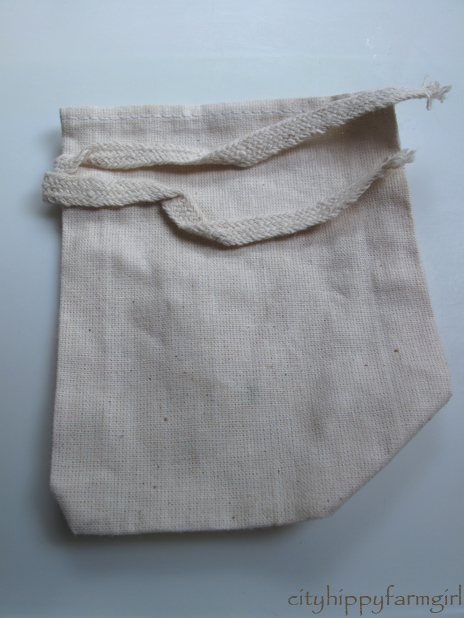
little cotton bag you put them in

Soap Nuts


So what are they?

“Soapnuts ( Sapindus mukorossi ) are an environmentally friendly, sustainably produced, bio-degradable and compostable alternative to commercial laundry detergents. Grown wild in India, for centuries these nuts have been used for many purposes, from laundry to cleaning jewellery and treating contaminated soil. They are most widely recognised as being an effective and environmentally friendly natural detergent, but can be used for a wide variety of other uses.” New Internationalist

Do they work?

Yep, they do. The clean just as well as any other laundry liquid I was using. There is no lingering soapy smell. There is a tiny and pleasant clean, fresh smell when I first get the washing out of the machine. You have to really stick your nose in the fibres to get it though and nothing residual once the clothing as dried. They also leave everything quite soft. No need for any fabric softners, (if you use it.) There is a really great indepth post here comparing the nuts with regular washing powder. The Monkeys don’t play neatly, and it manages to get all the grime off their clothes.

How expensive are they?

Not all. You only need to use 6-8 of the nut shells in a load and then they are then re-used for another 4-6 times. All you need to do is dry them out in between washes and peg the little bag up when you dry your laundry. So the 500gm bag lasts for ages. New Internationalist (where I got mine) claims they will last for about 6 months doing about 200 loads. That seems to be fitting in with how I’m using them too.

What do you need to do?

Put 6-8 shells in the little bag (3 are included) pop it into some hot water for a minute (I stick a bowl of water in the microwave) and then put the bag and water in with the load of laundry.

Is it too much of an extra effort to do it all the time?

Nope, not all. A minute to warm the water, and a few seconds to empty the bag to dry it and the shells. Super easy.

Can you use them for anything else?

I’ve only used them for laundry, but you can apparently use them instead of regular shampoo, hand wash, cleaning jewellery and pest control in the garden.

What to do with them when you are finished?

They can go in the compost or used as mulch in the garden.

Any problems?

No problems for me. I’ve been really happy with them, and will keep using them.

Some places to find them

new internationalist Australia

Wildsoapnuts.com Australia

www.soapnuts.co.uk

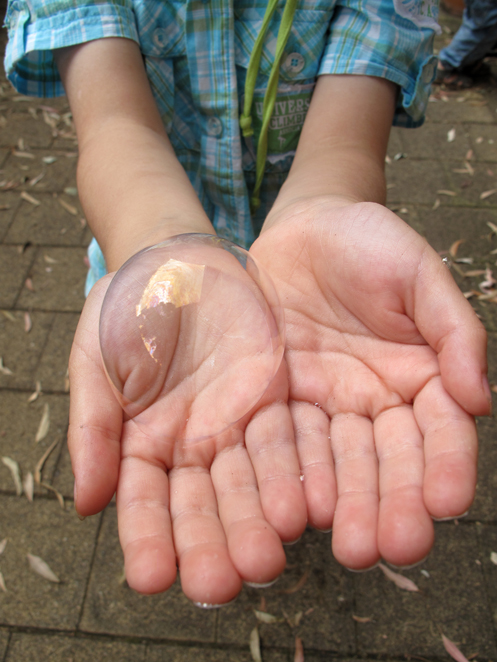
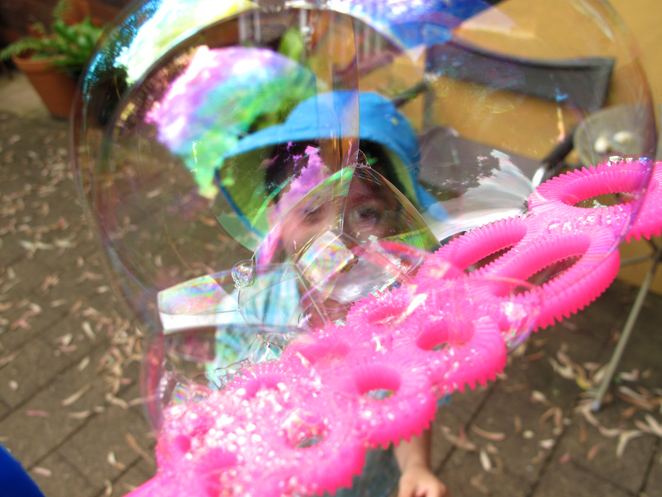
Bubbles, bubbles, bubbles…

Bubbles Recipe

Glycerine    1 part
Dishwashing liquid    2 parts
Water   7 parts

(Recipe is approximate. You may have to play with the ratios a little.)

Most kids get a kick out of bubbles. Actually I like bubbles, so perhaps there are a few adults out there too that would be keen for a bubble recipe. I just use my kids as an excuse to use them.

Bubbles love a wet environment. So if it’s humid, rainy kind of weather, perfect for bubbles. In the bath, with the bathroom door shut (trapping that moist air in ) perfect for bubbles. Snowing outside…I have no idea, but give it a go. It could  be perfect for bubbles. When the bubbles pop straight away they are drying out, the glycerine helps to stop that, and the moisture in the air as well.

Make your mixture up and leave it a few hours, or even over night (I’m not sure why, but it seems to work.)

You can use anything as your bubble maker. We had an empty container that had been given to us previously, but an old wire coat hanger twisted in to a circle can work just as well. Bigger bubbles!

Now go get to those bubbles.

(they also make a great inexpensive gift.)


* Where to buy glycerine from? Your local chemist. Not expensive and will do you quite a lot of bubbles.

meat…could you? would you?

I have meat on my mind. Not the usual thing on my mind and a little less exciting than the next sourdough to construct, but non the less it’s there.

A few things in blogland had prompted the thinking and also just a natural progression I guess of wanting to know where my meal comes from.

This household doesn’t eat a lot of meat. Monkey Boy and Mr Chocolate really enjoy it, but Little Monkey and I can take it or leave it. Free range chicken, organic minced beef, free range ham, and organic sausages seem to be the usual selection of what we choose from. Nothing too exciting there. Over the years, other meaty items just slowly got bumped off. Canned tuna, daily ham on sandwiches, fresh fish…all for various reasons, now don’t usually find themselves on our every day dinner table.

In my little world, the majority of our meat is bought from the supermarket, butcher, or if I’m lucky enough some farmers markets. Ideally what am I looking for? Meat that has been ethically raised, sustainably produced, not compromised on taste, and at a budget that doesn’t hurt the hip pocket. Is that just too hard though on a day to day level for most people?

Many people can’t argue with the convenience of a supermarket. However there is an increase in buying organic, local, free range pieces. If I can manage to get it, I love being able to buy meat either straight from the producer (easier at a farmers market) or at least knowing the area in which it is from and buying through a middle person.

Some of my recent meaty prompter’s…

Pick a pig– Friends put me on this link from the UK. A system that lets you buy your animal, it’s reared by the farmer, slaughtered and then gets delivered to you in the cuts you ask for. A large up front cost, but….you are getting a whole lot of pig there. Also you know where your pork cuts are coming from. I would love to know if there are any people doing something similar in Australia. On a large scale this is a really interesting way of cutting out the middle man. Another similar scheme again in the UK is Yorkshire Meats

Perennial Plate, an online short documentary style programme on sustainable foods- warning it is a little graphic.

Gourmet Farmer– you know I am a fan. What the man has documented on his show is his journey of going from city fella, to small town living. Rearing animals for his own consumption, learning how to kill chickens, and send his heritage breed pigs to the slaughterer.

Slow Living Essentials- cute fuzzy ducks, and I was thinking dinner.

So whats my beef? (every pun intended.)

Have we become completely desensitized to seeing animals being killed for our plate? I know I don’t feel completely comfortable with it. I would like to think I could do it. Raise an animal, bump it off and then eat it, but could I? I feel if I am willing to eat it, I should be willing to admit that cute little piglet is going to get its head taken off and make some truly delicious ham. It could be a real turning point to vegetarianism for me. However… I would like to think I could rear an animal and either assist in some way in the slaughtering process or do it myself…. Confronting as it most certainly would be.

When you see the meat being sold in the supermarket all wrapped in styrofoam and plastic, all cut up and ready to go. There is usually very little to show you that this pink piece of flesh was once a mooing four legged creature. Feathers still stuck to your chicken pieces? Most people get rather unhappy if this was the case. I remember unloading some groceries from the supermarket in Italy once and there tucked away under the cling wrap and styrofoam was Ms Guinea Fowls head still intact. In my world, I’m not used to that. If I see meat I don’t expect it still to look like the animal it once was. I don’t want any happy memories of a life it once had floating around the room still. But this also seems ridiculous…almost a little precious. It is meat, which means it used to be an animal. Is that as silly as denying a chip in front of me used to be a potato growing in the ground?

Is it merely enough to know what you are eating and where you bought it from? There being no need to kill it yourself, when some one else can do it for you? Will more people begin to choose their meat while thinking of it being sustainably sourced, organically produced, locally harvested and ethically raised. I would like to think so, but feel we have a loooong way to go first. It’s turning around a whole mind set. A whole meat eating culture that needs to be slowly changed.

Should we be taking a moment to acknowledge and honour the life that has been giving up for our plate?

I understand why someone would become a vegetarian for ethical reasons. I also understand why people truly enjoy eating meat. (we still talk about that pork dish at ARIA.) I do think however, that people should know where their dinner came from if at all possible. How many primary schools would teach young children about where their meat comes from? How many parents would talk about it to their young children? How many highschool students would get to study the make up of an animal, different breeds, how to raise them, slaughter, and then cook them? (Agriculture is a chosen subject, in very few highschools.) If this is a part of our every day lifestyle why wouldn’t we be able to learn about it from the beginning.

English, maths, science, food*.

Incorporate it in to learning how to grow, and harvest vegetables. Surely these are important principles that people seem to be so far removed from these days.

I’m still trying to work out where I stand with it all. It’s not easy. Do you eat meat because it’s there, it’s healthy, it’s what everyone else does? Do you eat all parts of the animal avoiding any wastage? I’m not a fan of any kind of offal, however it does seem rather silly to breed a huge beast for consumption and then only eat half of it.

I would like to think that any meat I ate was treated as humanely as possible in their life beforehand. A chance to live as a young calf, piglet, lamb should, before going ‘down town’. Being mindful of every mouthful of meat that I eat. Being thankful that a life has been given up to feed my families belly’s. Thinking about it where it came from and not taking it for granted that I am here and I need and deserve to eat that eat meat! Happy paddock loving animals look differently to large production ones. Australians are one of the top meat eating countries in the world. A weekend BBQ isn’t usually a success unless there is an array of meaty goodies on offer.

Now I could waffle on and on about this meaty topic and go round and round in circles. For the sake of not boring you all to numbing tears I wont. However I will pass this over for discussion. (Feel free to disagree.)

What do you believe in?

Is buying our meat at the supermarket simply progression? Modern times. We have moved on from backyard butchery. A time now of convenience of food…

Do you consider where you meat comes from when selecting it for the dinner table?…

Do you like having that distance between you and that furry beast/ succulent juicy steak on your plate?

Could you rear and slaughter your own animals for eating if you had access to it. (Either via someone elses farm and livestock, or your own.)

…and would you want to?

*******

* I know that in some wonderful schools the Edible School Yard programme or Kitchen Garden programme is up, running and doing really well. This is still a minority in most schools as far as I am aware though. It is also still dependent on the community to get it up, running and maintaining it.
wrap it a little differently

I really like thinking of new ways to give presents to people. I’ve always thought it was a bit funny the idea of buying gift paper, wrapping a present and then watching it being ripped to shreds by the recipient. Not that I don’t like giving presents, I do. Actually I love it. However, if it’s expensive beautiful paper it seems like such a waste and if it’s cheap, well it’s still a waste. I’ve mentioned before using chocolate wrappers which if you go through the quantity that our household does certainly puts it to good use.

Christmas is still a little while away, but if you like these wrapping ideas they may take a little while longer to accumulate.

1/ Old maps make perfect wrapping paper. They are square and flat. Easily bought in second hand shops where they are quite often sold very cheaply as areas change. Places get outdated easily. Looks funky too, well I think it does. Add a ribbon or some wool, tying it up and gift is ready.

2/ Old movie or music posters. Quite often sold in music stores cheaply as they were advertising a band or album that was coming out. For the music or movie  fan this can make an exciting present….(well the wrapping of it anyway.)

3/ Turn your head slightly on the side and look at your food packaging slightly different. Bulk rice bought in a bag can be a wonderful way to present a gift. Linen sack of oats, beans, coffee can all be done the same way. Just have  a look around. This one is a zippered 5 kilo bag of basmati rice.

4/ Second hand stores are usually brimming with baskets of varying sizes. Save wrapping a present altogether and present it in a basket.

5/ Use retro fabrics, easily picked up in second hand places, (or auctions). Hold the fabric together using ribbons or wool.

6/ Use simple brown wrapping paper that hasn’t used dyes and decorate it yourself. Draw your kids hands all over it and get them to decorate it. Paint some flowers all over it. Or write little messages all over.

So many possibilities.

Bamboo Toothbrushes- you might want to try it

A little while ago I was trying to find out what my alternatives were to using the conventional plastic handled toothbrush. I’d like to keep my teeth, so the brushing twice a day for the rest of my life is quite the long term plan. Now if I changed my toothbrush every 3 months as reccommended. Add in the odd change of toothbrush after illness. Times that for the next 60 years (I’m optimistic). That’s a lot of toothbrushes!

All sitting in their landfill graves. Silently sitting and waiting to break down. Waiting…waiting…waiting…waiting…

Now there are a few alternatives out there on the market at the moment and I’m sure give it another few years and there should be a lot more readily available options to the average consumer. However for the most part, the average plastic toothbrush is what sells. Looking at a few of my options, I could get a 100% recycled plastic toothbrush, made from yoghurt tubs, (made in USA). I could use a twig from an appropriate tree, or I could use a bamboo handle toothbrush… Bamboo sounded good.

Step up, The Environmental Toothbrush. Simple biodegradable packaging, looks just like the picture and how does it brush?…

Really well! The head is small enough to get in at the back teeth. The bristles are soft, works well on the gums and that little fella knows how to clean. To be honest I was slightly hesitant when I first saw it. How can something so basic looking work so well? However after giving it a go, I was left nodding to myself muttering that’s a good tooth brush, and with sparkly clean teeth to show for it.

The toothbrush was designed by an Australian dentist. It’s biodegradable, environmentally sustainable. When you throw it out, it simply breaks down into compost.

If you would like to give this toothbrush a red hot go, (not the one I was using obviously!) I’m giving one away. To get one for your pearly whites, tell me something about teeth or bamboo. Anything you like. An interesting fact about bamboo, or a story about your Nana’s false teeth, what ever takes your fancy…Post a comment by the 3rd of November…seriously, it’s a really good toothbrush.

* Top photo from G magazine online.

EDIT- Congratulations to Christine from Slow Living Essentials for getting the Bamboo toothbrush.